Timber flooring in coastal and humid Australian climates
How salt air, slab moisture, monsoonal wet seasons and air-conditioning decide whether a timber floor stays flat from Fremantle to Cairns.
Marcus Bell, Timber editor · 2026-05-06
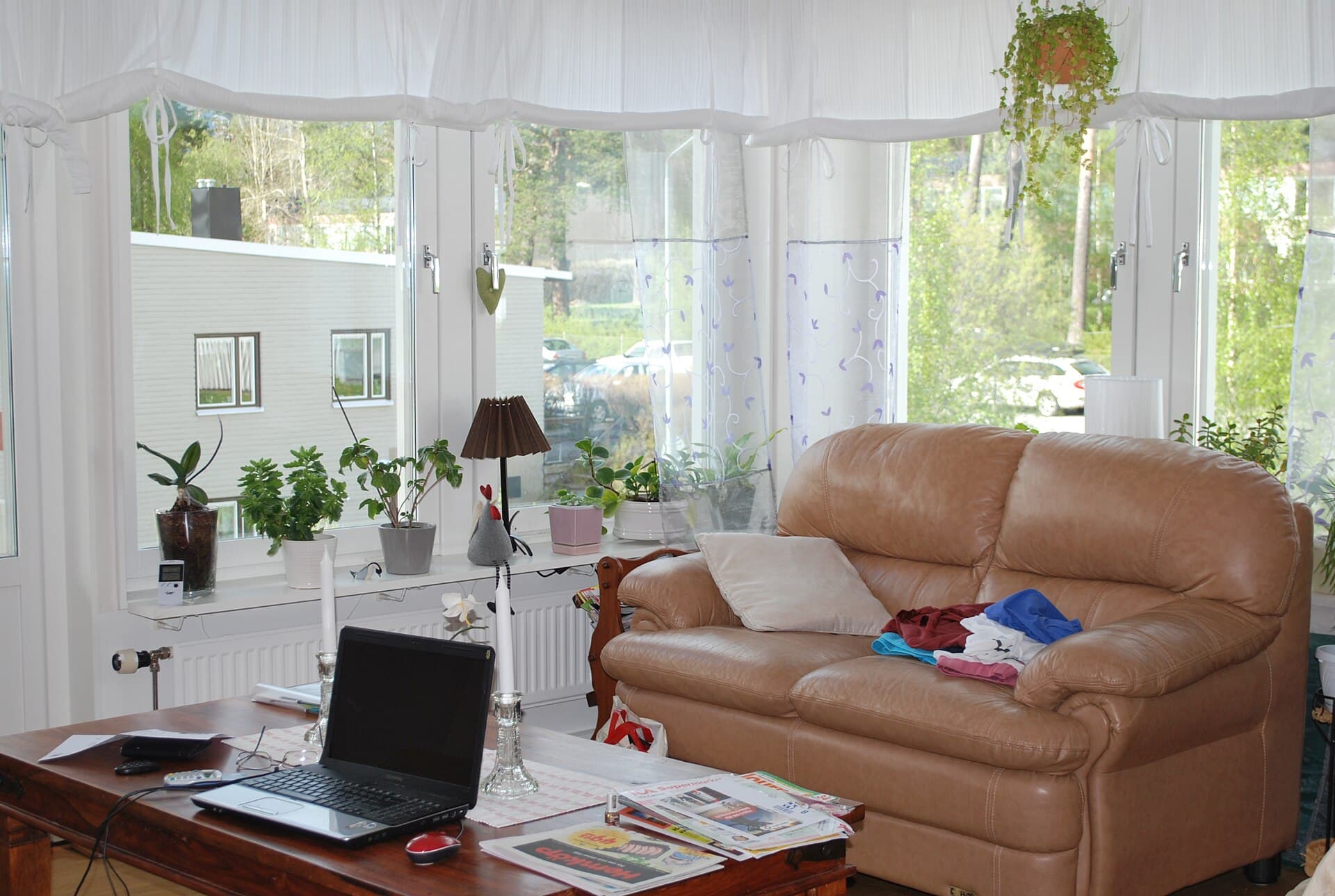
Photograph: A furnished living room with a timber floor. by Linsenhejhej. Source on Wikimedia Commons, licensed CC BY-SA 3.0. See all image credits.

Australia does not have a timber climate. It has several, and they are rude to floors in different ways. A Fremantle limestone house dries boards until you can see daylight between them. A Cairns wet season fattens them. A Sydney beach apartment gets both: salt, sand, and a sliding door that funnels rain onto the threshold while the air-conditioner tries to turn the lounge into a supermarket.
If you want a eucalypt or oak floor in any of those rooms, you are doing moisture management that happens to look like interior design. This essay is the climate companion to solid versus engineered timber and to flooring for Queenslanders and slabs.
What humidity actually does to a board
Timber is hygroscopic. It takes on and gives off water until it agrees with the surrounding air. Across the width of a board, that shows up as shrinkage gaps, cupping (edges up), crowning (middle up), and, in engineered product, as veneer checking or core swelling if water sits in the joints.
Lengthways movement is smaller, which is why long hallways still need expansion breaks. The myth is that “acclimatising the boards in the room for two days” solves this. Acclimatisation helps the boards meet the house. It does not freeze the weather in June.
Coast: salt, sand and the door that always leaks a little
Coastal floors fail from abrasion as much as from vapour. Sand is sandpaper. Salt holds moisture against metal fixings and can leave a tacky film on oiled floors. Specify a finish you can recote, not a fragile matte film you are afraid to mop. The cleaning and maintenance guide is written with sandy hallways in mind.
Thresholds deserve a drawing. A flush track looks beautiful and will ship rain onto the first metre of parquet. A small upstand, a drainable sill, and a mat well are not unromantic. They are how the floor survives a southerly.
Engineered boards, especially with a plywood core, remain the default overlay in beach apartments because they move less across a slab that is itself taking salt air through every weephole. Solid overlay can work in more protected coastal houses with generous expansion and a species that has a reputation — Spotted Gum and Blackbutt are the usual shortlist.
Humidity without the beach: Brisbane, Darwin, the tropics
Raised timber houses in the humid north and east can be kind to solid floors if the underside is open, dryable, and not a termite motel in a plastic wrap. The moment you close the subfloor “for pests” without thinking about drying, you have built a mushroom farm.
On grade, in the wet season, slabs can sit above the moisture content your timber warranty allows. Measure. Do not take a builder’s “she’ll be right, we poured in May”. Engineered helps. It is not a submarine. Standing floodwater is a restoration event, not a product category.
Air-conditioning is a tool, not a personality. A house held at 22 °C and moderate humidity is a gift to timber. A house that is shut and refrigerated for five days, then opened to a 80 per cent weekend, is a movement machine. If you live like that, a more stable overlay or even a hybrid floor in the worst rooms is adult.
Apartments, stacks and the neighbour’s shower
Multi-storey coastal buildings collect leaks. A timber floor that is also an acoustic system cannot be ripped up casually. Glue-down engineered on a tested acoustic mat is usually the specification that strata, the acoustic engineer and the timber can all live with. Floating floors that drum when the kids run are how by-laws get written.
If the unit above has a shower that weeps, no species will save you. Find the leak. Then talk about floors.
Spec notes for a humid or coastal timber job
- Demand a written moisture number for the slab or subfloor, and a stop-work if it fails.
- Prefer narrower boards if you insist on solid in a twitchy climate; wide solid boards are drama.
- Leave expansion where the manufacturer drew it, including at kitchen islands.
- Choose finishes you can maintain after sand walks in; oil systems are often more repairable, as we argue in oil versus polyurethane.
- Keep timber out of the shower and be sceptical of any “waterproof timber” claim. Wet rooms are tile assemblies or certified sheet systems.
- Budget for more frequent recoating than a Canberra sitting room would need.
When to walk away from timber
If the brief is a beach shack that is hosed out, a tropical house that floods, or a rental whose tenants will put a dripping esky on the floor every weekend, timber is a love letter to a future complaint. There are honest waterproof and water-resistant floors; they are filed under vinyl, laminate and hybrid and tiles.
If the brief is a well-detailed house that you will actually maintain, timber in a coastal or humid climate is not reckless. It is just not casual. Floorscapes would rather you spent the money on sills and moisture meters than on a wider board.
Termites, salt fixings and the metal you cannot see
Coastal and humid timber jobs fail in hidden hardware as well as in the face. Secret nails, tracks in salt air, and fasteners into damp joists are a corrosion story. Specify metals that belong near the sea. Termite management is a building system, not a flooring SKU. A beautiful Blackbutt overlay over a wet, dark crawl space is a larder. Inspections and a dry ground line under a Queenslander are part of the floor specification in the north and east.
In cyclone and flood geographies, a timber floor is a recovery problem. Solid boards can sometimes be dried and recote if they did not sit in sewage. Engineered floors with swollen cores are often waste. If your house floods as a habit, timber in the lowest rooms is a love letter to a skip. Tile, a grind of the slab, or a sacrificial resilient floor will let you live there. For true wet rooms, stay with bathroom tiles.
A lot of mysterious cupping next to ensuites is steam. Exhaust fans that do not extract, showers without doors, and dryers that vent into the house will move more moisture into a timber floor than a coastal breeze. Fix the wet rooms as assemblies, then blame the climate.
A cheap hygrometer in the living room and another in the subfloor will tell you more than a salesperson’s climate anecdote. Timber likes boring relative humidity. If you can keep the house in the band the manufacturer published, you can have eucalypt boards in places the internet says you cannot. If you cannot, you wanted a more stable overlay, a narrower board, or a different material in the worst rooms. Budget recotes, mats and sills the way you budget for paint in the salt.
People also ask
- Can you have timber floors in a beach house?
- Yes, if you choose a stable construction — often engineered — detail expansion, control moisture at doors, and do not treat the living room like a wet area. Salt and sand are abrasion problems as much as humidity problems.
- Does air-conditioning stop timber floors moving?
- It can reduce swings if it runs steadily. Blasting it cold all week and then opening the house to a humid weekend is how you get gaps and peaks. Timber prefers boring, consistent air.
- Is solid timber a bad idea in Queensland?
- Not if the subfloor dries and the species and detailing are honest. Raised Queenslanders with ventilation can be excellent for solid boards. Sealed wet slabs in the wet season are not.
Continue in the Timber floors hub or read the Floorscapes editorial standards. Pitch a related essay on the write for us page.