Australian hardwood species for floors: Blackbutt, Spotted Gum, Jarrah and Tas oak
How Australian floor species actually behave — hardness, colour, grain, availability and which rooms they belong in — beyond the sample-board names.
Marcus Bell, Timber editor · 2026-03-04
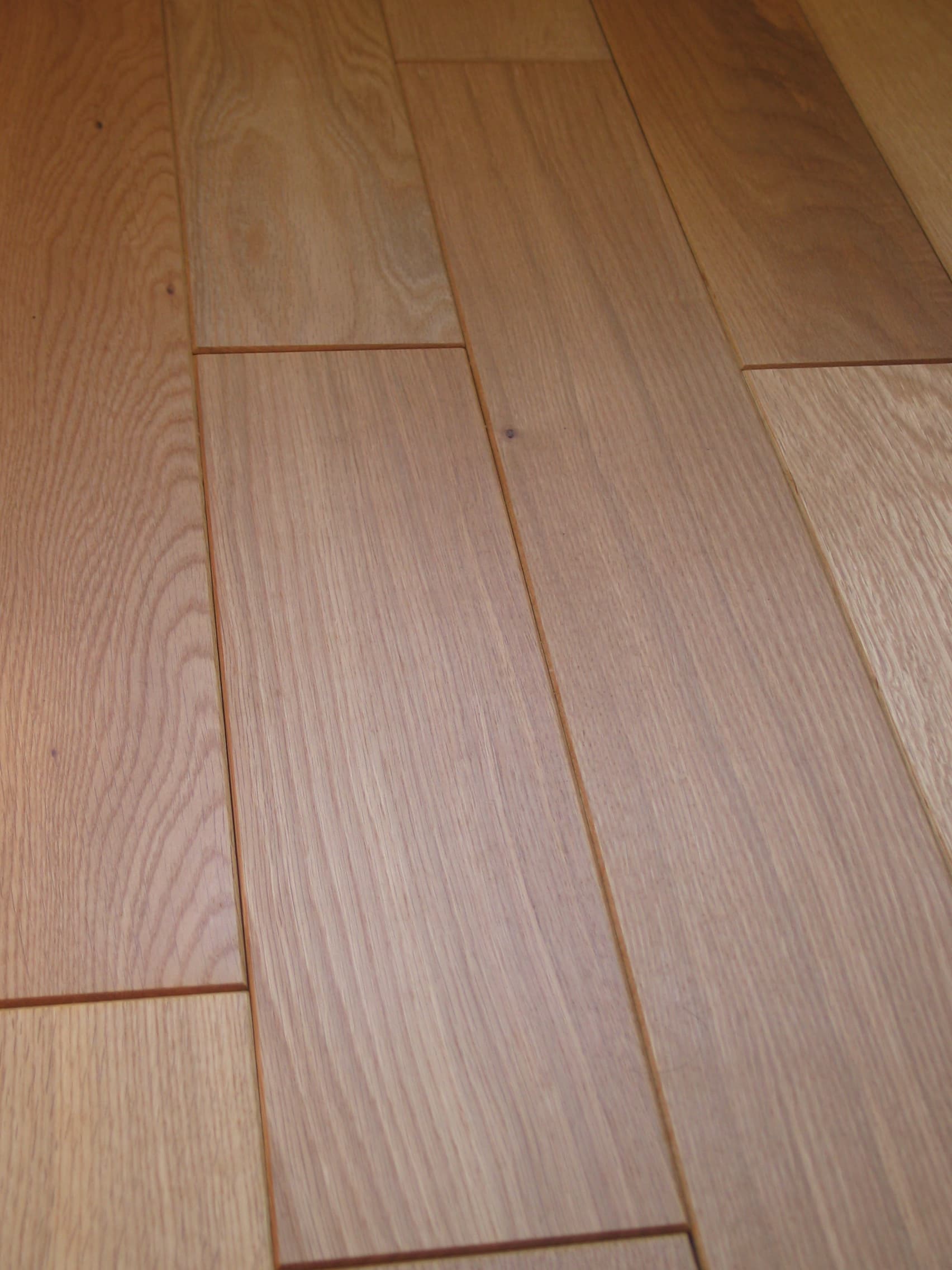
Photograph: Solid oak floorboards with a chamfered edge and rustic grade. by DocteurCosmos. Source on Wikimedia Commons, licensed CC BY 3.0. See all image credits.

Australian floor showrooms still sell a shortlist as if it were a national anthem: Blackbutt, Spotted Gum, Jarrah, Tasmanian oak, maybe Sydney Blue Gum if the merchant is feeling lyrical. Those names are real species (or, in the oak’s case, a real group of species) with different colours, hardness, movement and supply stories. They are not interchangeable beige.
This guide is about how those boards live in houses, not how they photograph under a showroom spot. Read it with solid hardwood versus engineered timber open in another tab, because construction and species are a pair.
Blackbutt: the default blonde, until it isn’t
Blackbutt (Eucalyptus pilularis) is the pale, slightly pink-brown workhorse of east-coast floors. It has a relatively even grain, a reputation for hardness that survives family life, and enough supply that you can still match boards on a renovation if you are not fussy about the exact mill run.
It is not white. In afternoon north light it reads honey; against a cool grey wall it reads almost pink. People who wanted “Scandinavian oak” and bought Blackbutt are the people who later ring us about floor colours in Australian light. If you want it paler, you are talking white pigmented oil or a wash, not a different tree.
Blackbutt moves. It is not the most temperamental eucalypt, but it will gap in a Perth heater winter and swell on a Brisbane slab if you rush the moisture. It takes stain less evenly than European oak, which is a blessing if you like timber to look like timber.
Spotted Gum: the floor that photographs itself
Spotted Gum (Corymbia maculata and related species) is the interlocking, wavy, fiddleback-prone species that interior photographers chase. Hard, visually busy, and capable of going from blonde ribbons to dark chocolate in a single board. Feature grade is a room. Select grade is still not quiet.
It is a serious candidate for high-traffic family rooms and for coastal houses that need hardness plus a bit of natural oiliness. It is a poor candidate if you wanted a mute, continuous plane under mid-century furniture. Mix it with a busy terrazzo kitchen and you will have two patterns shouting.
Janka hardness figures put Spotted Gum among the species that laugh at chair casters. They do not laugh at standing water. No eucalypt floor is a wet-area system; keep it out of showers and be honest about the laundry, as we are in the hybrid flooring in wet areas essay.
Jarrah: Western Australia’s dark argument
Jarrah (Eucalyptus marginata) is the Floorscapes home state’s famous floor: deep red-brown, hard, historically over-logged, now a more considered specification. In a Fremantle limestone cottage it looks inevitable. In a white inner-west terrace it can look like a pub if you do not control the other materials.
Jarrah darkens and then, in strong UV, can brown further or patch where rugs live. Finish choice matters. A hardwax oil will look different from a film polyurethane in six summers; that is the whole point of oil versus polyurethane.
Supply is not the same as Blackbutt. If you are matching an existing 1970s Jarrah floor, read matching new flooring in a renovation before you order a truck of “close enough”. Close enough is a stripe across the dining room.
Tasmanian oak: the pale eucalypt with a European nickname
Tasmanian oak is mostly Eucalyptus delegatensis, E. obliqua and E. regnans sold as a blended pale hardwood. It is not Quercus. It is the Australian answer to the question “can we have something quieter than Spotted Gum and cooler than Blackbutt?”
It dents more readily than Ironbark. It is a favourite for interiors that want grain without a heavy red cast. It also shows every splash of red wine and every dog bowl ring if you choose a matte oil and never recote. Hardness is mid-pack for Australian floors: tougher than European oak, softer than the ironbarks.
Victorian ash, sold separately or mixed, occupies a similar colour world. Ask what is actually in the pack.
Sydney Blue Gum, Ironbark and the rest of the bench
Sydney Blue Gum can be a stunning pink-grey floor and a difficult matching exercise. Ironbarks (grey, red) are brutally hard and often used where the brief is “this hallway will be destroyed otherwise”. Brush Box turns up in older Queensland houses. Recycled messmate and mixed Victorian hardwoods appear in warehouse conversions that want a story more than a uniform colour.
Imported European oak — solid or engineered — is now a huge part of the Australian market because the design culture wants a calmer grain. It is a legitimate floor. It is not an Australian hardwood, and it will not behave like one in our UV. If the brief is “quiet, pale, wide plank”, oak engineered is often the grown-up choice. If the brief is “this house is a eucalypt landscape”, buy a eucalypt.
Hardness is not a personality test
Janka numbers are useful and over-trusted. A hard floor can still wear a finish to velvet in a kitchen pinch point. A slightly softer floor with a well-maintained oil can look better at year eight than a harder floor with a cheap film that yellowed and cracked. Kids, dogs and chair felts do more than species selection. For pets specifically, skip ahead to the best flooring for pets in Australian homes.
Stability — how much the board moves across its width — is the quieter number. Wide boards in a twitchy species on a wet slab are how cupping case studies get written.
Colour, grade and the sample-board lie
A 200 mm sample is a postcard. Ask for a square metre laid in the room, or at least a handful of boards from the actual batch. Feature grade in Spotted Gum is a different product from select Blackbutt, not a different filter on the same photo.
Australian light does the rest. A south-facing Melbourne living room will cool a Jarrah until it is almost chocolate. The same boards in a west-facing Adelaide afternoon will go live-coal red. Test, do not imagine.
Specification notes that actually matter
- Prefer boards from a mill that publishes average moisture content at dispatch, not just a species name.
- Keep the same board width through an open plan unless you are deliberately changing rooms; mixed widths read as leftover stock.
- For stairs, order extra. Treads eat the pretty boards.
- For herringbone, confirm the species is available as shorts with a wear layer you can live with.
- If BAL bushfire overlay or decking is in the same visual family as the interior floor, do not assume the same species is legal or stable in both places.
Species is the poetry. Moisture, subfloor and finish are the plumbing. Floorscapes will keep publishing both, because a beautiful name on a wet slab is still a complaint.
People also ask
- What is the hardest Australian hardwood for flooring?
- Among the commonly sold floor species, Spotted Gum and Ironbark sit at the very hard end of the Janka scale, with Blackbutt not far behind. Hardness is not the same as stability, and a hard floor can still cup on a wet slab.
- Is Tasmanian oak actually oak?
- No. Tasmanian oak is a trade name for a group of pale eucalypts, mainly ash-type stringybarks. It behaves more like a blond Australian hardwood than like European oak.
- Which Australian timber floor suits a coastal house?
- Spotted Gum and Blackbutt have strong track records in humid and coastal work when they are detailed properly. Jarrah prefers a more stable, drier interior. Species choice never replaces a moisture plan.
Continue in the Timber floors hub or read the Floorscapes editorial standards. Pitch a related essay on the write for us page.