Bathroom floor tiles in Australia: slip ratings, membranes and wet-area rules
P ratings, R ratings, AS 3740 and why a beautiful polished tile is not a bathroom floor until the assembly underneath is waterproof.
Priya Nair, Tiles and wet-area editor · 2026-01-14
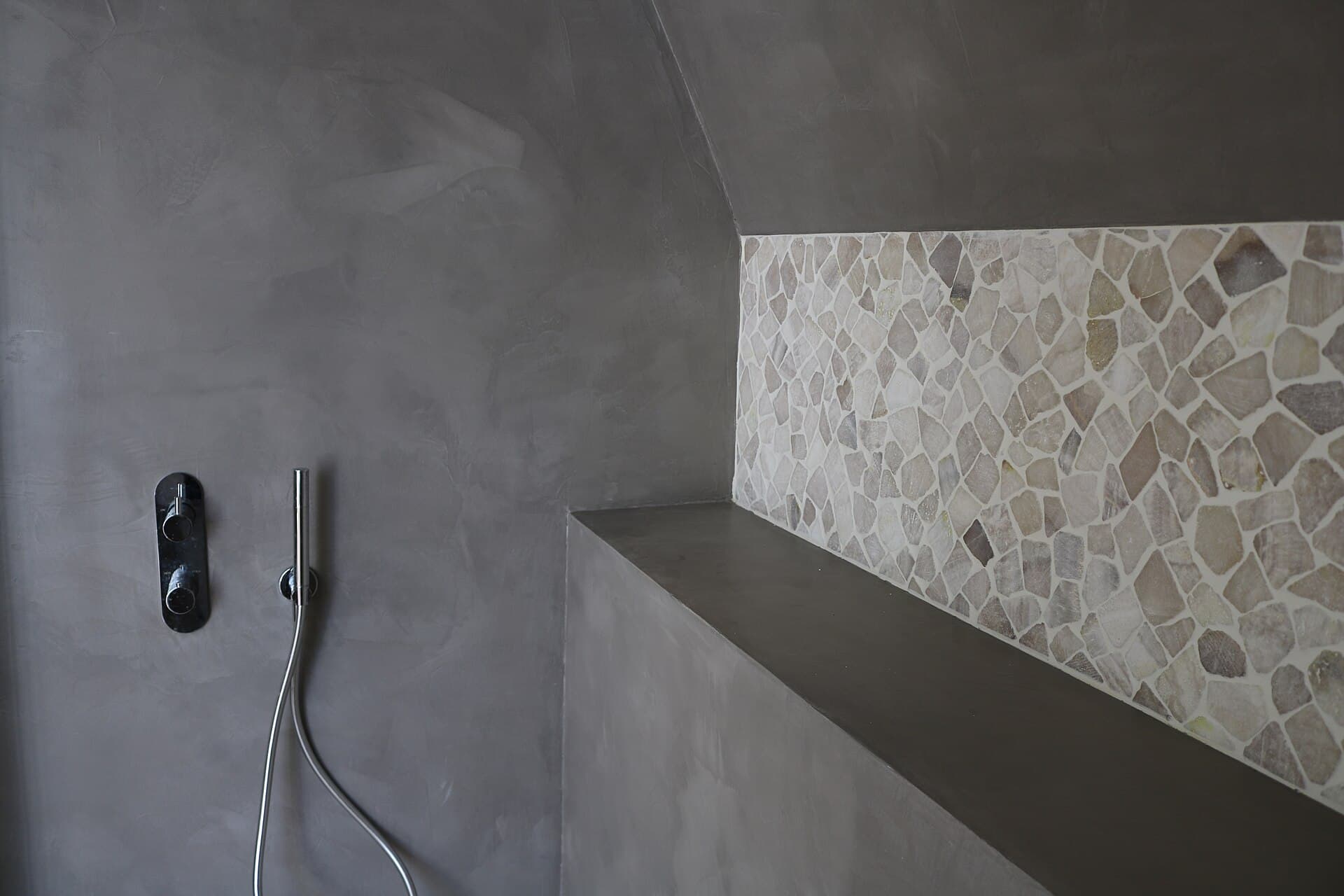
Photograph: Microcement (beton ciré) bathroom floor and wet-area finish. by Alex van Olst. Source on Wikimedia Commons, licensed CC BY-SA 4.0. See all image credits.

A bathroom floor has two jobs that interior photography likes to pretend are one: it has to look like the rest of the house, and it has to keep people upright and the downstairs ceiling dry. Australian wet areas are not a vibe. They are an assembly under the National Construction Code, with AS 3740 in the conversation and AS 4586 on the slip ticket.
This is the piece to read before you fall in love with a polished 1200 mm porcelain in a wet room. Pair it with porcelain versus ceramic and hybrid flooring in wet areas if a salesperson is trying to float a timber-look board through the shower.
The tile is not the waterproofing
Write it on the wall of every showroom. Waterproofing is the membrane, the upturns, the penetrations, the waste, the falls. The tile is a wearing surface stuck to a bed stuck to that membrane. A porcelain with almost no absorption is still a tray of grout joints. Water will find them if the assembly underneath is theatre.
AS 3740 is not a poster. Your builder and waterproofer have to build a system that meets the NCC performance in your state, with the details your certifier will actually look at. Shower screens do not make a floor a shower. Falls to the waste do.
Microcement and seamless finishes, like the bathroom on our cover, are their own specialist systems. They are not “paint on the tiles” and they are not automatically a substitute for a membrane. Treat them as proprietary assemblies with their own trained installers.
Slip: P ratings, R ratings, and wet feet
AS 4586 is the test method behind the P (pendulum) and R (ramp) ratings you see on data sheets. In a residential bathroom that is regularly wet, P3 is the usual starting conversation; R10 is the ramp-test cousin people quote. That is a minimum in many briefs, not a medal.
If anyone in the house is older, very young, or unsteady, P4 / R11 is a kinder floor. Shower floors want texture you can feel with a soapy foot, which is why mosaics and structured porcelains still belong there even when the dry vanity zone is a larger tile.
Polished anything in a shower is a hotel photograph. Hotels have night cleaners and lawyers. You have kids and conditioner.
Entry tiles that get rain on a winter night are a related problem; the same standard shows up at the front door. Do not specify a lobby polish for a beach-house mud room.
Falls, wastes and the large-format fantasy
A single 1500 mm slab in a shower looks uninterrupted until you realise water has nowhere honest to go. Falls are a geometry. Small formats and mosaics follow that geometry. Large formats fight it, then get ground into a pretence of a fall that still ponds in the corner. Large-format tiles are often better in the dry zones of a bathroom than in the shower tray.
Floor wastes should be where water runs, not where the plumber found a joist gap. Linear wastes have made better drawings possible; they have not abolished falls.
What does not belong in the shower
- Solid and engineered timber, including “wet-rated” marketing that is really a kitchen-spill warranty. See timber in humidity.
- Ordinary laminate.
- Carpet, obviously, and most hybrid click floors unless the exact range is approved — which you verify, not infer.
- Cushioned vinyl offcuts from the laundry unless it is a welded, coved, wet-area sheet system.
Sheet vinyl, done properly with coving and welded seams, is still a legitimate, warm, genuinely waterproof bathroom floor, especially in rentals and accessible bathrooms. It is not glamorous. It works.
Cleaning, grout and the decade after handover
Structured tiles hide slip risk and show soap scum in different places than polish. Grout in showers needs a maintenance habit or an epoxy system; sealing tiles and grout is the unglamorous sequel.
If you want a continuous look from hallway timber into the ensuite, do it with a related colour, not with the same product. The junction can be beautiful. The product cannot be the same if one side is a shower.
A specification order that keeps people out of tribunals
- Falls, waste, membrane — draw them.
- Slip rating for the actual wetness of each zone.
- Tile body and format that can follow the falls.
- Then the colour that matches the kitchen and hall.
Reverse that order and you will get a beautiful, lethal, leaking room. Floorscapes would rather you were bored on the data sheet than interesting on a crutches.
Accessible bathrooms, kids’ bathrooms and the hotel photograph
An accessible bathroom wants a slip rating you can defend with a wet soapy foot, a threshold a wheelchair or walker can cross, and a waste that actually sees the water. That often means a structured tile or a sheet system, a level shower with a linear waste, and grab rails that were in the drawing, not screwed into a wet plasterboard after a fall. Fashionable pebble mosaics can be kind underfoot and cruel to clean; they can also be excellent shower floors if the falls are real.
Kids’ bathrooms die from puddles and from products. A polished large-format “spa” floor with a glass screen that does not meet the tray is a weekly flood. Choose texture, a screen that belongs to the waste, and a grout that can take shampoo. Heated towel rails do not dry a pond.
Ventilation is part of the floor. Steam that has nowhere to go condenses, feeds mould in grout, and then everyone blames the tile. A fan that extracts to outside, used during and after showers, will do more for grout colour than a sealer cult. Sealing grout is still worth doing in cement systems; it is not a substitute for air.
Renovating an old bathroom on timber joists is a stiffness and waterproofing job before it is a tile job. Ply, a specified board, a membrane with upturns, then the tile. Skipping to a pretty porcelain on a bouncing floor is how grout becomes a grid of hairline cracks in a year. If the house is a Queenslander or weatherboard, look at the structure with the tiler and the waterproofer in the same visit.
The hotel photograph was lit by a lighting designer and cleaned by a night team. Your bathroom is cleaned by you, at speed, with a child shouting. Specify for that.
People also ask
- What slip rating do I need for a bathroom floor in Australia?
- For residential wet areas, P3 (pendulum) or about R10 is a common minimum conversation. Households with children, older people or mobility risk should look at P4 / R11. A shower floor often wants more texture than a powder-room vanity zone.
- Are tiles waterproof?
- The tile body may absorb very little water. The floor is only a wet-area floor if the membrane, falls, junctions and waste are built as a system under the NCC and AS 3740. Grout lines are not a membrane.
- Can I use hybrid flooring in a bathroom?
- Only if the exact product is approved for that wet area, which many are not. A floating timber-look board is not a substitute for a tiled, membrane-backed shower. See our hybrid wet-area essay.
Continue in the Tiles and stone hub or read the Floorscapes editorial standards. Pitch a related essay on the write for us page.