Solid hardwood vs engineered timber flooring in Australia
A practical Australian comparison of solid hardwood and engineered timber — veneer thickness, slabs, humidity, sanding life and what the price actually buys.
Marcus Bell, Timber editor · 2026-02-11
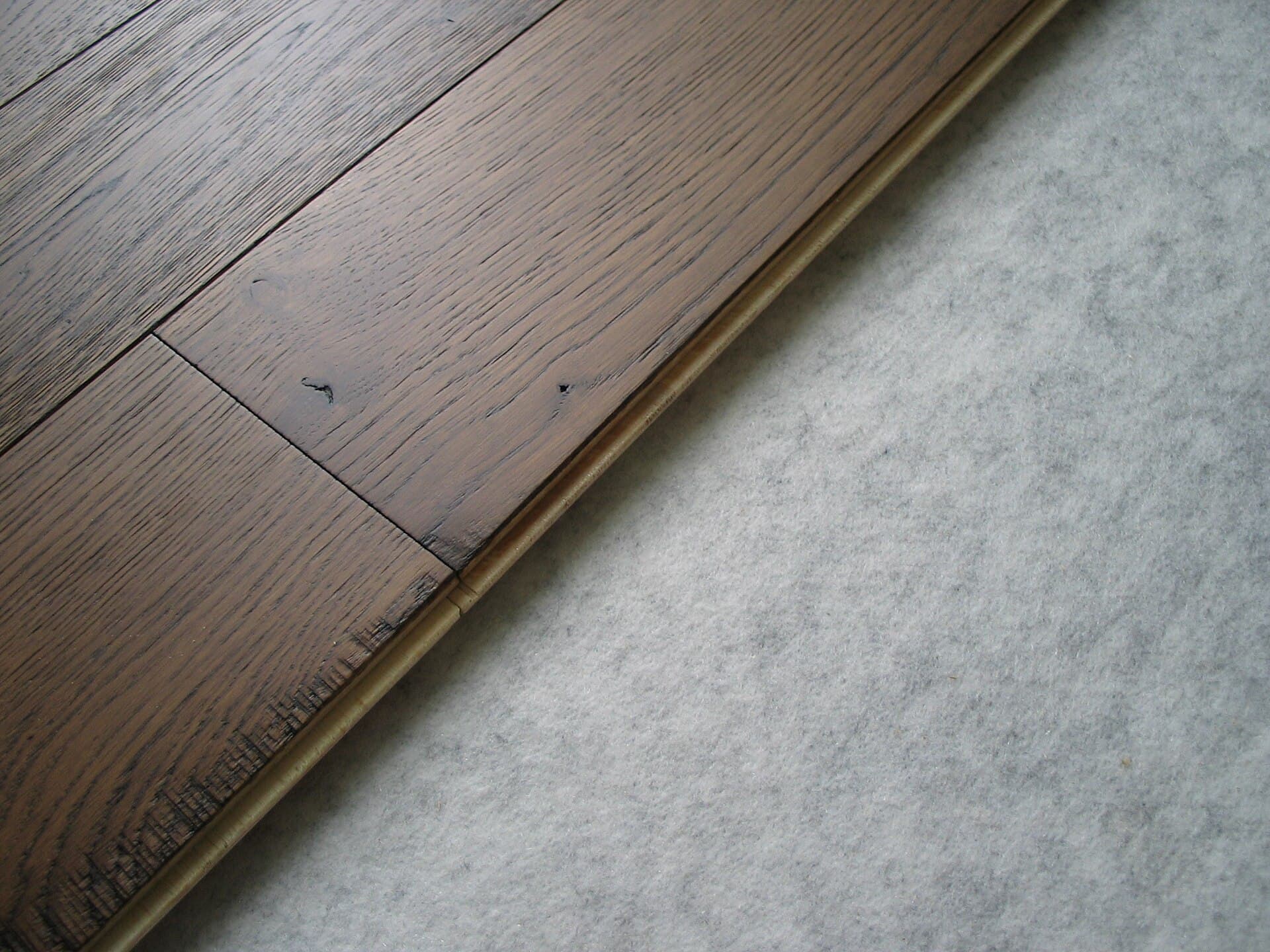
Photograph: Tongue of an engineered (contrecollé) parquet board, showing the layered core. by DocteurCosmos. Source on Wikimedia Commons, licensed CC BY-SA 3.0. See all image credits.

The argument between solid hardwood and engineered timber is usually staged as a morality play: real versus fake, heirloom versus laminate-in-a-suit. Australian houses are less romantic. They sit on concrete slabs that still breathe moisture in March, on bearers that move in a dry January, and in rooms that swing from air-conditioned cold to unshaded west-facing heat. The better question is not which product is more authentic. It is which construction will still be flat after the second summer.
This piece is the timber desk's working comparison. It sits beside our Australian hardwood species guide and the 2026 timber flooring cost guide, because species and price are downstream of construction.
What “solid” and “engineered” actually mean
A solid board is one piece of timber from face to back, typically 19 mm in a traditional Australian secret-nailed floor, sometimes 12–14 mm in overlay boards. You see the same species all the way through a cut end. When you sand it, you are still in that species.
An engineered board is a sandwich. A wear layer of real hardwood is glued to a core — plywood, or sometimes a high-density fibreboard — with a balancing veneer on the back. The point of the sandwich is dimensional stability: ply runs in crossing grains so the board wants to stay flat when humidity moves. That is why engineered is the default overlay on Australian slabs, and why it is the honest answer in many coastal units.
Neither product is a floating vinyl. Both are timber on the face. The difference is how much timber you are buying, and what the board is allowed to do when the house moves.
Stability on slabs, bearers and in apartments
Most new Australian houses are slab-on-ground. Concrete holds water for a long time. AS 1884 is the resilient-flooring installation standard, but timber manufacturers write their own moisture limits, often expressed as a relative humidity or a slab moisture percentage that must be measured, not guessed. If you ignore that number, solid boards cup. Engineered boards are not immune — they can still peak, delaminate or telegraph a damp slab — but they are designed to move less across their width.
On a traditional bearer-and-joist floor, solid hardwood is still a beautiful structural finish. Boards are secret-nailed, they can be sanded hard, and they have a way of becoming the house. Queenslanders and weatherboard cottages with good subfloor ventilation often suit solid boards better than a thin engineered overlay, provided the underside can dry after rain. If the subfloor is a sealed wet hole, neither product will save you; you fix the crawl space first. That is the same logic we use in flooring for Queenslanders, weatherboards and slab homes.
Apartments add acoustic rules and a prohibition on many sanding jobs. Engineered, floated or glued to a tested acoustic underlay, is usually the product the strata report will tolerate. Solid overlay is possible in some buildings and a diplomatic incident in others.
Wear layers, sanding and the length of the life
This is the paragraph salespeople skip. A 19 mm solid Blackbutt floor can be sanded several times over thirty or forty years if you do not grind it into a dish. An engineered board is only as renewable as its wear layer.
- 0.6–1 mm decorative veneer: do not plan a full sand. Repair, bleach, maybe a light screen and recoating if the manufacturer allows it.
- 2–3 mm: one careful professional sand may be possible.
- 4–6 mm: closer to the old European idea of a parquet you live with for decades.
If the pitch is “engineered that you can sand like solid”, ask for the wear-layer millimetres in writing. Then ask whether the stain is through the veneer or a surface coat. A stained 2 mm oak that you sand once may come up a different colour.
Solid is not maintenance-free either. It still needs a finish system — oil or polyurethane — and a recoating calendar, which we unpack in oil versus polyurethane timber floor finishes.
Humidity, coast and air-conditioning
Australian humidity is not a single climate. A Perth summer is dry enough to shrink boards until gaps open like tram lines. A Brisbane February can swell the same species until edges peak. Darwin is its own argument. Coastal apartments from Bondi to Scarborough add salt air and sliding-door floods of rain.
Engineered handles those swings more politely, which is why it dominates the timber floors in coastal and humid climates conversation. Solid still belongs in many of those rooms if you choose a species with a reputation for stability, leave expansion gaps that are not filled with silicone as an afterthought, and do not run the air-conditioner like a meat locker all week and then open the house to a northerly.
Underfloor heating, increasingly specified in southern renovations, also pushes the decision toward engineered or a manufacturer-approved solid overlay. Direct-stick solid on a hydronic slab is a specialist job, not a weekend one. See underfloor heating and flooring in Australian homes.
Appearance, grade and the honesty of the face
Both constructions can be graded as select, standard, feature or rustic. Both can be smoked, limed, wire-brushed or left almost raw. Herringbone and other parquetry patterns are now more common in engineered than in solid simply because the shorter pieces are cheaper to manufacture in a stable sandwich — the pattern itself is covered in our herringbone and parquetry guide.
Where solid still wins on looks, for many editors, is in the way light hits a thick arris and in the way a repaired board can be let in from the same pack years later. Engineered batches change. Keep a square metre in the cupboard.
Cost, installation and what the quote hides
In 2026, typical installed Australian ranges still put mid-grade engineered over a prepared slab somewhere around $128–$210 per square metre, and solid hardwood closer to $159–$260, with feature grades and parquetry climbing from there. Those are not quotes; they are the bands we discuss in the timber flooring cost guide. What moves a job between the bottom and the top of the band is rarely the species name on the sample. It is slab grinding, moisture testing, acoustic underlay, trims, staircase winders, and whether the old floor has to come out through a second-floor window.
Solid secret-nail over joists is a different trade to glue-down engineered. Do not let a floating-floor crew learn on your Blackbutt.
A working decision rule
Choose solid hardwood when you have a dry, ventilated timber subfloor, you want to refinish hard, and you like the idea of the floor being a structural finish rather than a costume.
Choose engineered when you are on a slab, in an apartment, in a humid coastal room, over hydronic heating, or when the architect wants a wide plank that would cup if it were solid.
If a salesperson tells you engineered is “maintenance free” or that solid “never moves”, walk. Timber moves. The product you want is the one whose movement you can live with, finish, and — when the time comes — repair. That is also the spirit of our guide to repairing scratches, gaps and cupping.
People also ask
- Is engineered timber better than solid hardwood in Australia?
- It is more stable over a concrete slab and in humid rooms, but it is not automatically better. If the wear layer is thin you cannot sand it like a 19 mm solid board. Choose by subfloor, climate and how many times you want to refinish.
- Can you put solid timber on a concrete slab?
- Yes, but only with a tested moisture barrier, the right adhesive or secret-nail system, and a slab that has actually dried. Many Australian slabs are still too wet for solid boards months after pour. Engineered is the more forgiving overlay.
- How many times can engineered timber be sanded?
- A 2–3 mm wear layer might take one careful sand. A 4–6 mm wear layer can often take two or three. Anything advertised as a 0.6 mm veneer is a photograph of timber, not a floor you refinish.
Continue in the Timber floors hub or read the Floorscapes editorial standards. Pitch a related essay on the write for us page.