How to sand and polish timber floors in Australia
When a full sand is warranted, what the dust and days actually look like, and how recoating differs from grinding a floor back to raw timber.
Marcus Bell, Timber editor · 2026-02-18
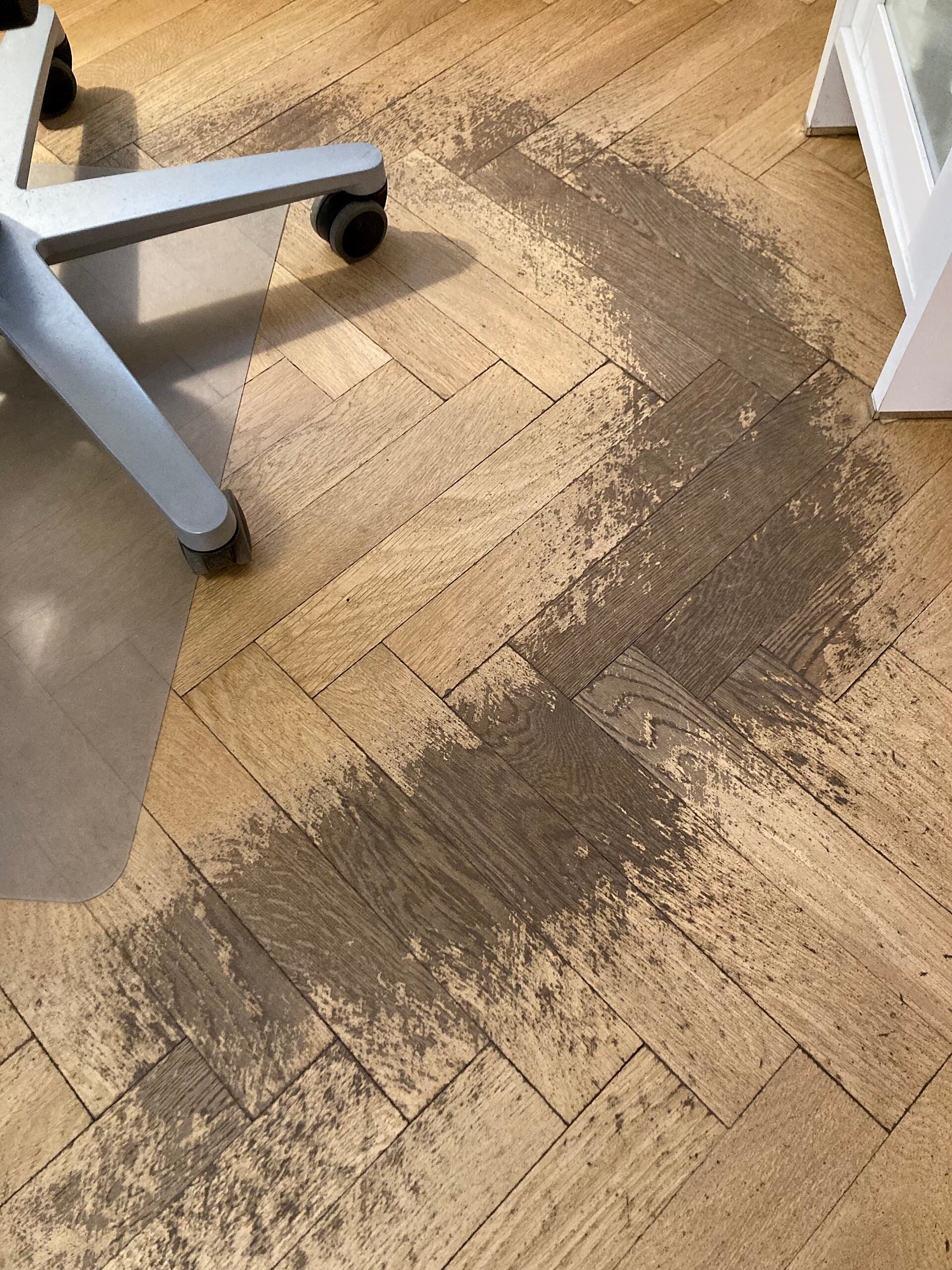
Photograph: Worn finish on historic oak herringbone parquet, showing traffic wear. by Kai Kemmann. Source on Wikimedia Commons, licensed CC BY-SA 4.0. See all image credits.

“Sand and polish” is Australian shorthand for a cluster of different jobs: a light screen and recote that keeps a good floor going, a full grind that takes the finish off, and the edge work that actually decides whether the room looks professional. People book the third when they needed the first, and they book the first on a veneer that cannot survive it.
This is the process essay for the finishes hub. Species sits in the hardwood guide; coatings in oil versus polyurethane.
Recoat versus resand
If the finish is worn in paths but still stuck to the timber, a professional screen (a careful abrasion) and new coats will usually look better than a full sand, cost less, and leave millimetres of timber in the bank. Our cover photograph of worn parquet is a recote candidate if the wear has not gone through to fibre.
If the finish is peeling, if stains have gone into the board, if there are dish-outs from a previous cowboy, or if you are changing colour through the timber rather than with a stain on top, you are in full-sand territory.
Engineered floors with thin wear layers may only ever get a recote. See solid versus engineered before you hire a machine that eats millimetres.
What a full sand actually does to a house
Dust, even with good extraction. Days without the room. Stairs that become a crime scene. Pets boarded. A smell if you choose a solvent polyurethane. Water-based systems are kinder to the household and to yellowing, with their own skill requirements.
Edges and corners are the tell. A beautiful field with a halo of old finish at the skirting is an amateur job. Good crews spend the time you cannot see on Instagram.
Repairs — splits, proud nails, broken tongues — happen before the last grit, not after the first coat. Gaps, cupping and scratches should be diagnosed before the sander arrives; cupping is a moisture problem, not a grit problem.
Coatings, coats, and the calendar
A sand without a specified coating system is half a job. How many coats, which system, which sheen, whether a stain or a white pigment is involved — write it down. Matte hides more in family rooms; gloss shows every claw and every lip of filler.
Drying times are not suggestions. Walking on a floor “because it feels dry” is how you get sock marks forever.
Recoating cycles in Australian traffic are often three to five years in hallways, longer in bedrooms. Coastal sand shortens them — coastal timber.
Cost bands, not quotes
National chatter in 2026 still puts a straightforward full sand and coat somewhere around $30–$70 per square metre, with stairs, repairs, fillers, and fancy oils extra. Screen-and-recote is less. If two quotes differ wildly, they are not describing the same number of coats or the same repairs.
DIY machines from the hardware aisle
You can destroy a floor with a hired drum sander in an afternoon. Dish-outs, waves, and burned timber are not a rustic look. Edges are worse. If you love the house, pay a floor sander. If you insist, practise in a wardrobe.
Aftercare the week you get the floor back
Felt pads, no wet mopping parties, no rugs for the period the coating manufacturer names (rugs too early stain like a map). Then return to ordinary cleaning.
Sanding is not a personality reset. It is maintenance, expensive when delayed, cheap when timed. Floorscapes is in favour of recoating sooner and grinding later.
Fillers, stains and the colour you only discover on day two
Old Australian floors are full of gaps, nail holes, and previous fillers that are a different species in disguise. Water-based fillers move with the seasons differently to solvent relics. If you fill winter-tight gaps, summer will spit the fill like spaghetti. The repairs essay is the diagnostic; the sanding day is too late to start thinking.
Stains and white pigments go on after the last sand, before the coats, and they will look different at 4 pm than at 9 am. Sample in the room. A grey wash that looked European under the finisher’s work light may go mauve in a west window. Light does not clock off because you booked a sander.
Stairs, nosings, and hallways wear faster and are often a different timber if a previous owner economised. A “whole house sand” that ignores that the treads are pine painted to look like oak will reveal a confession. Inspect before you quote yourself a colour fantasy.
Neighbour politics in terraces and units: sanders are loud. Building rules may limit hours. Dust still travels. A good crew talks to neighbours. A cheap crew talks to nobody and you live with the notes under the door. Budget the politics as well as the grit.
Health, VOCs and living in the house
Solvent polyurethanes still exist and still smell. If anyone in the house is sensitive, budget a water-based system and a night elsewhere. Pets should not walk the wet film. A sand is a short construction project in your hallway. Treat it like one: plastic to the kitchen, a kettle somewhere else, a date when the felts go back on. The coating calendar starts at handover, not at the first dinner party.
Edges, vents and the furniture plan
Floor vents, heat registers and tight radiator gaps are where amateur sanding burns timber. Professional edges take time. Move furniture out, including the bookshelves you swore were empty. A sand around half-full rooms is how you get a halo of old finish under a sideboard you will one day move. Empty the room. It is cheaper than a second visit.
After the coats: rugs, pets and the first fortnight
The first fortnight is when socks print, dogs write signatures, and rugs stain like continents if you rush them back. Follow the coating manufacturer’s clock, not your dinner party calendar. Put felts on immediately. Keep the dog to the tiles if you can. A perfect sand ruined in ten days is a common Australian tragedy. The sander cannot babysit the film. You can.
People also ask
- How much does sanding and polishing a timber floor cost in Australia?
- Typical 2026 ranges for a full sand and coating sit around $30–$70/m² depending on condition, stairs, edges and coatings. A screen-and-recote is less. Quotes should say how many coats and whether repairs are included.
- How often should timber floors be sanded?
- Not often. Recoat the wear path every few years. A full sand is for when the finish is gone, the floor is stained through, or the boards are uneven. Over-sanding thin overlay and engineered veneers is how you buy a new floor.
- Can engineered timber be sanded?
- Only if the wear layer is thick enough. Many 0.6–2 mm veneers cannot take a full sand. Check millimetres before you book the machine.
Continue in the Finishes and care hub or read the Floorscapes editorial standards. Pitch a related essay on the write for us page.