Large format tiles: layout, grout joints and lippage in Australian rooms
Why 600, 900 and 1200 millimetre tiles fail on dished slabs, how grout width and layout drawings save the job, and when a smaller tile is the braver specification.
Priya Nair, Tiles and wet-area editor · 2026-03-18
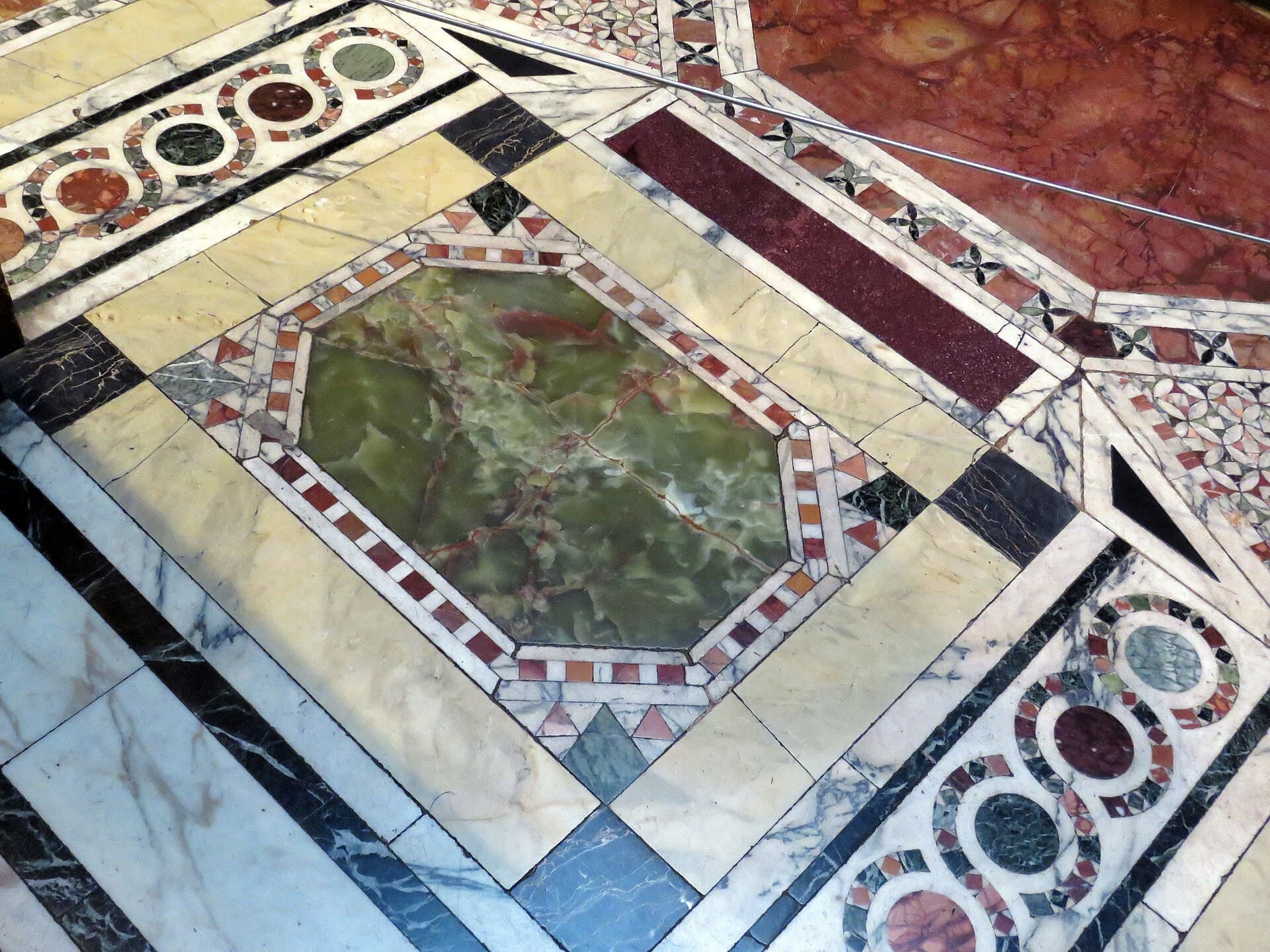
Photograph: Marble floor tiles laid in a geometric pattern. by Acabashi. Source on Wikimedia Commons, licensed CC BY-SA 4.0. See all image credits.

Large-format tiles promised Australian interiors a calmer floor: fewer grout lines, more stone, more “gallery”. What they also promised, quietly, was a new way to fail. A 1200 mm porcelain is a ruler. It will measure your slab, your hallway dish, and your tiler’s patience, then publish the results in raking afternoon light.
This is a layout and substrate essay. For body type, see porcelain versus ceramic. For wet rooms, see bathroom slip ratings.
What “large format” means on a real floor
In domestic work we now treat 600 × 600 mm as normal, 600 × 1200 mm as fashionable, and anything over a metre as a specialist sheet of ceramic. Book-matched slabs and sintered stone are a further jump: they are cladding systems as much as tiles.
The larger the piece, the less it can twist to follow a hollow. Tiles are not perfectly flat; manufacturers publish warpage tolerances. Two slightly crowned 1200 mm tiles butted with a 1 mm joint will lip. That lip is what your eye finds from the sofa, and what your foot finds at night.
Substrate preparation is the specification
A “pretty good slab” is not a large-format substrate. You grind ridges, fill dishes, and check with a straightedge that would embarrass a vinyl installer. The same discipline as floating floor subfloor prep applies, except the penalty for cheating is a stone-look trip hazard.
On timber, stiffness matters. A tile underlay on well-fixed plywood or a specialist board can work. Direct-stick to old pine boards that bounce when the washing machine spins will crack grout in a season. Sometimes the honest upgrade is to stiffen the floor, not to buy a bigger tile.
Grout joints are structural, not stylistic
Hairline grout is a magazine crop. Rectified edges allow tighter joints than cushion-edged ceramics, but they do not repeal physics. A 2–3 mm joint, filled with a grout that can move a little, is often the difference between a floor that lasts and a floor that clicks.
Dark grout hides the kitchen; light grout shows everything and then discolours except where the fridge stood. Sample grout in the actual light. Sealing, where the grout needs it, is covered in sealing tiles and grout.
Epoxy grout in wet or staining rooms is a different product with a different installer skill. It is not a magic wand for a lippy floor.
Layout is a drawing, not a vibe
Start from the room’s important sightline — the hallway axis, the island, the window — not from the corner the tiler put the bucket in. A sliver cut against a feature wall is a design failure you will see every day.
Open plans that mix large tiles with timber need a planned junction: a border, a threshold, a change of plane. Dumping a reducer strip where the glue ran out is how open-plan flooring looks tired.
Herringbone or brick-bond patterns with large rectangles need even more substrate honesty. A 600 × 1200 mm brick-bond on a dished slab is lippage with a pattern.
Light, polish and the afternoon interrogation
Polished large formats in a west window will show every lip as a highlight. Honed and structured finishes forgive more. If you want polish, spend the money on preparation, not on a glossier tile.
Australian raking light is harsher than European catalogue light. We wrote about this for timber in floor colours and Australian light; tiles are not exempt. Stand a sample on the actual floor at 4 pm.
When a smaller tile is the braver choice
- Old houses with movement joints that need to be expressed.
- Showers that need falls to a waste; mosaics and smaller formats still do this more honestly than a single slab with a fake fall.
- Tight powder rooms where a 1200 mm tile is two pieces and a prayer.
- Outdoor areas with falls and drainage, covered in alfresco tiling.
Large format is not more modern than a well-laid 300 mm tile. It is a different drawing. Specified with a flat substrate, a joint the tile can live with, and a layout that respects the room, it is one of the best quiet floors you can put in an Australian house. Specified as a shortcut to “less grout”, it is a glossy argument with gravity.
Movement joints, wet saws and the day on site
Large tiles need movement joints where the building already moves — at doorways between slabs, along long runs, against walls in some systems. Hiding every joint because it spoils the gallery look is how you get a tented floor in a Perth February. The joint can be a designed metal or a colour-matched sealant that you chose, not an afterthought crack.
Cutting 1200 mm porcelain on a cottage verandah is a specialist’s wet saw, not a score-and-snap leftover from ceramic days. Chipped corners on a rectified edge cannot be hidden in a 1.5 mm joint. Order extra, and accept that the first and last tiles in a hallway may be cuts. If those cuts are slivers, the layout failed. Go back to the drawing before the adhesive is open.
Book-matched slabs and sintered stone are a further jump in handling, sealing of edges, and substrate stiffness. They can be extraordinary on a feature wall that happens to be a floor in a powder room. They are a poor first large-format experiment in a bouncing weatherboard kitchen.
Lighting design is part of tile design. Downlights in a grid will pick every lip as a highlight line. If you are committed to polish and metre tiles, spend on the slab and on a tiler whose last three jobs you have walked in raking light. Then still consider a honed finish. Australian sun is not European catalogue sun. The colour and light essay is about timber; the physics is the same.
If the existing floor is a 1970s 300 mm tile that is flat and sound, sometimes the conservative reuse or overlay system is smarter than a fashion for 1200 mm that the hallway dish cannot take. Large format is a drawing quality, not a moral improvement.
People also ask
- What is tile lippage?
- Lippage is when one tile edge sits higher than its neighbour. On large rectified tiles it shows as a ridge that catches light — and toes. It comes from an uneven substrate, poor bedding, or a joint that is too tight for the tile’s warpage.
- How wide should grout joints be on 600 mm tiles?
- Follow the manufacturer, but many 600 mm rectified porcelains still want 2–3 mm, not a hairline. Warpage in the tile itself needs somewhere to go.
- Can you lay 1200 mm tiles on a timber floor?
- Only with a substrate system designed for it — often a tile underlay or a very stiff, quiet floor. Old springy joists and metre-plus tiles are how you write a callback.
Continue in the Tiles and stone hub or read the Floorscapes editorial standards. Pitch a related essay on the write for us page.