Outdoor and alfresco tiling for Australian weather
Slip ratings, thermal movement, drainage and frost — how to specify an outdoor tile that survives sun, storms and bare feet on a January deck.
Priya Nair, Tiles and wet-area editor · 2026-04-22
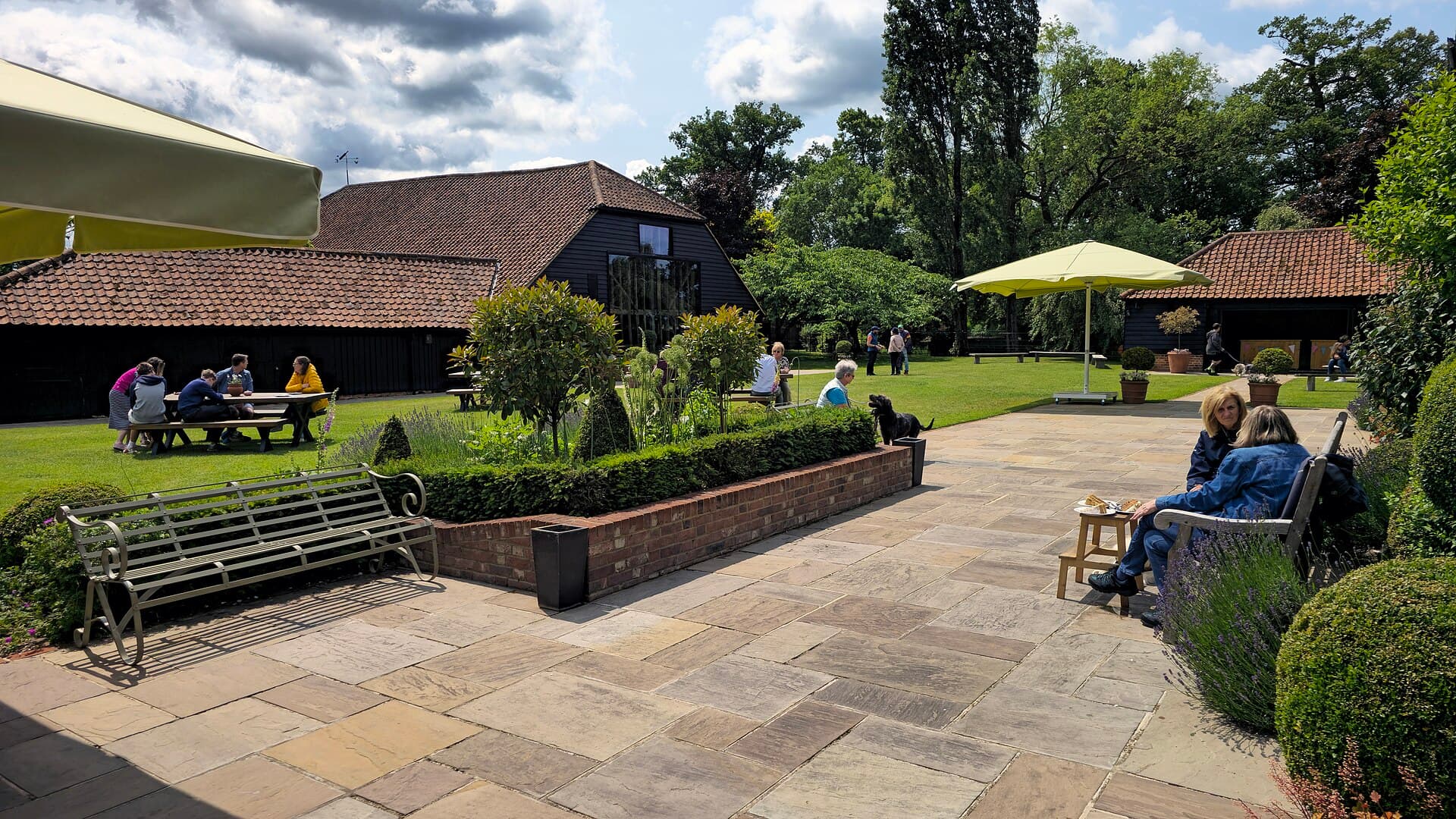
Photograph: Outdoor patio paving beside a listed barn. by Acabashi. Source on Wikimedia Commons, licensed CC BY-SA 4.0. See all image credits.

The Australian alfresco is not a European terrace with a polite drizzle. It is a room without a full roof, or with a roof that still lets in wind-driven rain, that must take greasy tongs, wet towels, dogs, and a 40-degree slab in January. Tiling it as if it were a hallway with a plant is how you get a skating rink that then splits.
This is the external companion to porcelain versus ceramic and bathroom slip ratings. The standards conversation still includes AS 4586. The climate conversation is ours.
Exposure, not the furniture
Ask what the sky actually does to this floor. Fully covered, wind-blown rain only? Open to the zenith? Pool splash? South of the divide with frost? Darwin wet season? Each is a different tile, adhesive, and joint.
A “20 mm outdoor porcelain” is a product category, not a free pass. Thickness helps for pedestal systems and some overlays; it does not invent drainage. Pedestal-set 20 mm slabs over a waterproofed deck are a legitimate way to get a flat furniture plane with a drained void. Direct-stick on a dished concrete pad with no falls is a pond.
Slip when it rains, because it will
Bare feet and a film of rain are the design case, not the dry Saturday in the photo. Structured, shot-blast, or otherwise textured finishes belong outside. Polish belongs in a foyer with a mat. If you want the same visual family indoors and out, many ranges now offer a matching structured external tile. Use it. Do not run the indoor polish through the bi-fold.
P4 is a serious number for wet external pedestrians. Pool copings and ramps can go beyond. If a salesperson says the tile “feels fine when dry”, they are describing a different planet.
Heat, colour and the January foot test
Dark charcoal tiles on a north-facing Perth terrace will burn skin. Light tiles will glare and show tannin from the eucalypt. Test a sample in the sun, not under a showroom downlight. Thermal movement in dark, large formats is why you express joints where the manufacturer and Australian practice say, not where the grout colour looks nicest.
Adhesives must be external-rated. Cheap interior glue on a west wall’s floor is a demolition plan.
Drainage is the drawing
Falls away from the house, not toward the sliding door. Outlets that are not decorative afterthoughts. If the alfresco is over a habitable room, you are in waterproofing territory as serious as a bathroom, plus UV. That is not a DIY membrane weekend.
Junctions to internal timber or hybrid need a sill that assumes water. Flush thresholds look magazine-ready and then host a flood. A small level change is architecture, not a mistake.
Frost, salt and the unfashionable failures
Alpine towns need frost-rated bodies. Coastal alfresos need surfaces that will not become a salt rink and metals that will not dissolve. Sand is abrasion; choose a finish you can clean with a stiff broom, not a white grout you intend to keep virginal.
Terracotta, used honestly, can be a beautiful Australian outdoor floor — see our terracotta cover on the credits page — but it wants sealing, a maintenance habit, and a climate it understands. It is not a porcelain lookalike.
Layout and lippage, outdoors
Raking sun is even crueller than indoor west light. Lippage outside is a genuine trip. Large formats need a flatter pad than most existing patios provide. Sometimes the conservative 400 mm paver is the modern choice because it can follow a real fall.
A short external spec
- External-rated, UV-stable tile with a wet slip rating you can defend.
- Falls, drainage, and a membrane if there is a room below.
- Movement joints, external adhesive, and a grout that can live in weather.
- A threshold that assumes rain, not a photo shoot.
- A cleaning plan that includes leaves and fat, not only “pH-neutral luxury”.
The best Australian alfresco floors disappear under a table of people who did not slip. That is the brief. Everything else is a sample board.
Pedestals, 20 mm porcelain and the roof you do not have
Pedestal-set 20 mm outdoor porcelain over a waterproofed deck is a legitimate way to get a furniture plane with a drained void and services you can still reach. It is not a cheap patio. Heights at doors, wind uplift in some geographies, and the look of the open joint all need a drawing. Direct-stick remains the right answer on many ground slabs with honest falls.
A pergola that leaks at every second sheet is still an outdoor floor. Specify for rain. A fully enclosed sunroom that you treat as a living room can sometimes take an indoor-rated tile, but condensation and wet dog traffic may argue otherwise. Be honest about the roof.
Barbecue fat, tannin from eucalypts, and sunscreen are the stain list. A honed light limestone look will show all three. A structured mid porcelain will forgive two of them. Cleaning with a stiff broom and a cleaner that does not kill the slip rating is part of the specification. High-pressure washers used like a weapon will strip grout and then the internet will be blamed.
Pool surrounds are a specialist cousin: constantly wet, chemically aggressive, full of running children. The slip number goes up, the colour often goes down in lightness to hide water marks, and copings are not leftover floor tiles on their side. If the alfresco is also the pool surround, the stricter brief wins.
Planting against tiled edges needs a soil and irrigation plan that does not flood the membrane. Garden beds that sit above finished floor level and drain toward the house are how indoor timber next to the bifold dies. Design the ground, then the tile.
Furniture loads, umbrellas and point loads
Pedestals and some outdoor tiles have load limits. A cantilever umbrella in a weight base is a point load that will write a star into a thin tile. Check. Outdoor kitchens add grease and heat at the plinth; a different tile or a metal tray at that strip is not a visual failure.
If the alfresco is your living room for six months of the year, specify it with the same seriousness as the indoor plane, plus rain. That is the entire outdoor brief.
People also ask
- Can I use indoor porcelain tiles outside?
- Only if the data sheet rates that exact tile for external use, UV, moisture and slip. Many indoor porcelains are too smooth, too unstable in temperature, or untested for frost.
- What slip rating for an outdoor entertaining area?
- Treat rain as normal, not exceptional. P4 / R11 is a common serious specification for external pedestrian areas that get wet. Pool surrounds and ramps can need more.
- Do outdoor tiles need movement joints?
- Yes. Australian sun cooks dark tiles. Without expressed joints and the right adhesive, you get tenting, cracked grout and a floor that sounds hollow.
Continue in the Tiles and stone hub or read the Floorscapes editorial standards. Pitch a related essay on the write for us page.