Is hybrid flooring waterproof enough for Australian wet areas?
What SPC hybrid warranties actually cover in kitchens, laundries and bathrooms — and when you still need a tiled membrane assembly.
Priya Nair, Tiles and wet-area editor · 2026-03-11
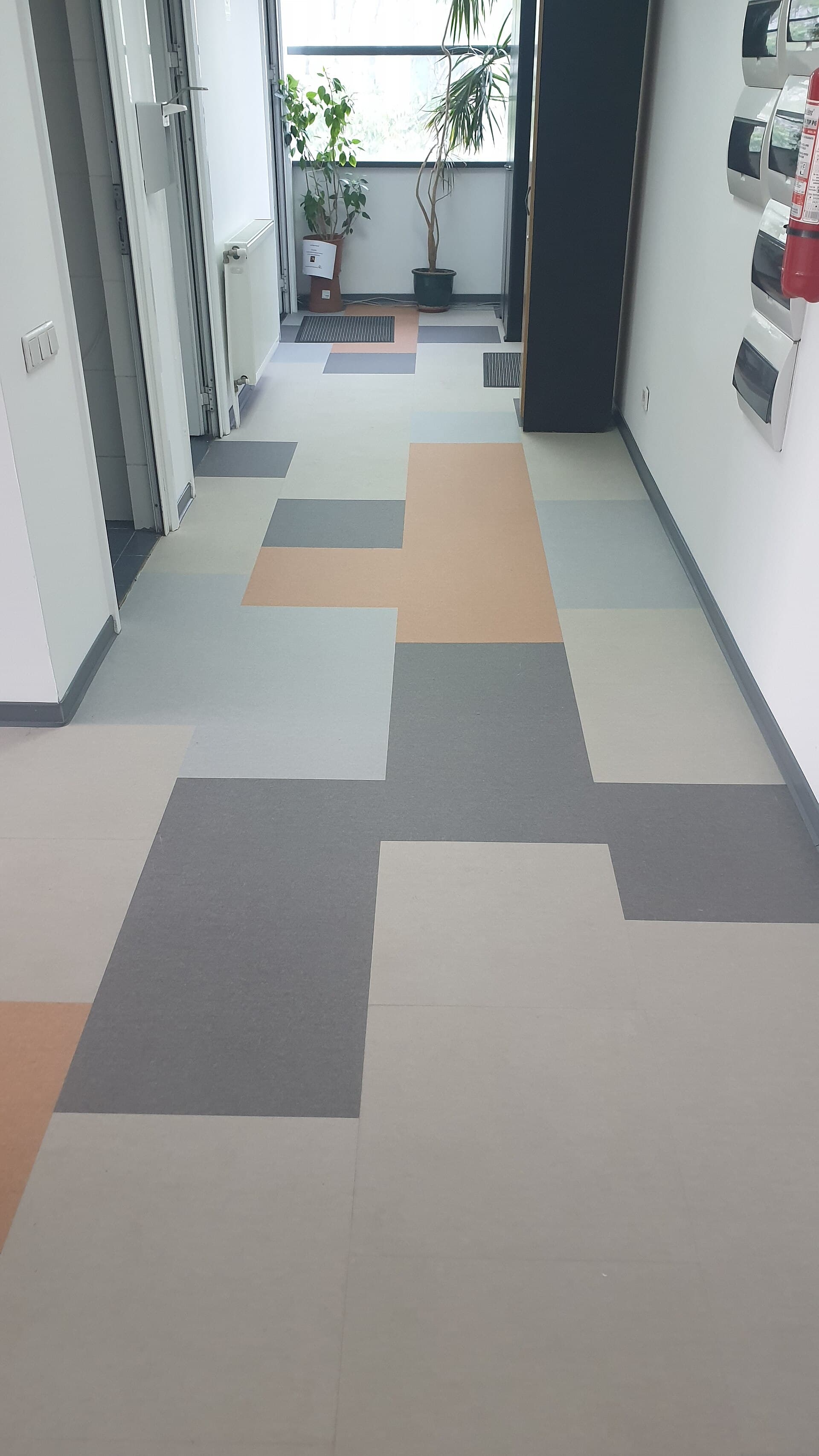
Photograph: Installed vinyl floor tiles in mixed colours. by Linoleum123. Source on Wikimedia Commons, licensed CC BY-SA 4.0. See all image credits.

“Waterproof hybrid” is the most successful sentence in Australian flooring marketing this decade. It is also the most incomplete. An SPC core does not swell like laminate’s HDF when a glass of water sits on it. That is real. It does not make the living room a wet area under the National Construction Code, and it does not make a shower legal.
This is the sceptical companion to hybrid versus laminate versus vinyl. If you need an actual bathroom floor, start with tiles, slip ratings and membranes.
What the core can and cannot do
A rigid stone-polymer core shrugs at a mop and at many kitchen spills. Edges still have joins. Water that runs through a click profile sits on the underlay and the slab. The floor can look fine while the particleboard kitchen carcass at the kickboard drinks, or while a timber underlay swells out of sight.
Warranties are the document. Some ranges allow kitchens and entries, exclude laundries, and treat bathrooms as a lawyered maybe. Some mention a cleanup window — wipe within X hours — which is another way of saying this is not a pond liner. Flood restoration is a different conversation from “the kids spilled juice”.
Kitchens: usually, with details
Hybrid in an Australian kitchen is often a good, honest floor. Detail:
- Dishwasher and fridge lines, which leak behind kickboards.
- The sliding door to the alfresco, which is a wet edge pretending to be a view. See alfresco tiling for the outdoor half.
- Expansion at the island, which is a wet mop magnet.
If the household cooks like a restaurant, a tile or sheet-vinyl zone in the pinch point is not a failure of nerve. It is kitchen flooring as a drawing.
Laundries: be harder to impress
Laundries combine standing water, vibration, and a waste. A floating floor with a pad can feel wrong next to a machine that walks. Many manufacturers exclude the room. A tiled plinth with a proper waste, or a coved sheet vinyl, is still the grown-up.
Bathrooms and showers: almost never the click floor
Showers need falls, a membrane, and a surface with a slip rating. A floating hybrid cannot create falls to a waste. It cannot be the waterproofing. Powder rooms that never see more than a drip at the vanity are the only bathrooms where some ranges will even talk to you, and even then you are often better with tile or sheet.
If a salesperson lays a hybrid sample in a shower set, leave.
Apartments, floods and the neighbour
Waterproof marketing is not flood insurance. If the upstairs shower fails, your hybrid may be the smallest part of the claim. Acoustic pads that hold water are their own mould story. Glue-down vinyl sheet, coved, is still how a lot of Australian clinical and rental wet rooms stay sane — see commercial vinyl and epoxy.
How to read the box without being hypnotised
- Room list in the warranty, not the lifestyle photo.
- Whether wet-area NCC compliance is even claimed (it usually is not).
- Edge profiles and whether a wet-area trims kit exists.
- What happens at 24 hours of standing water — in writing.
The honest map
- Kitchen/living with wiped spills: hybrid is often the point of the product.
- Laundry: tile or sheet unless the range is explicit and the waste is designed.
- Bathroom dry zone: maybe, with scepticism.
- Shower: no.
Waterproof is a property of a system. Hybrid is a board. Floorscapes will keep using both sentences.
Dishwashers, fridges and the kickboard climate
Most kitchen “waterproof floor” claims die behind a kickboard. A slow dishwasher leak, a fridge drip tray that overflowed, or a boiling-water tap install that was not sealed will sit in the dark and travel along a pad. When you finally smell it, the hybrid can still look fine. Pull a kickboard once a year if you are the worrying type. Detail silicone at the wet appliances as a serviceable joint, not as structural waterproofing.
Bathrooms that are only powder rooms still have a handbasin. Overflows happen. A cut-out around the vanity that is siliconed to a floating floor is a movement joint pretending to be a seal. Better: a tiled wet rectangle with a waste where the plumber can defend it, then hybrid beyond a designed trim. That is the same intelligence as open-plan mixed materials.
Flood restoration companies will tell you that some hybrids can be lifted, dried, and relaid if the lock survived. Some cannot. Photograph the batch codes. Keep leftover planks. If you live in a flood overlay, choose a system you are willing to throw away in the lowest rooms.
Marketing words to ignore: 100% waterproof, water proof core, stone composite therefore bathroom. Words to keep: room list, cleanup window, edge profile, NCC, membrane. Priya will keep repeating this until the aisle gets quieter.
Warranties, assessors and the sentence to keep
When something goes wrong, the assessor will ask for the product code, the room list, and the moisture number at install. Keep them. A lifestyle photo of a hybrid in a wet room is not a document. If the range excluded bathrooms, the Instagram tile was advertising, not consent.
If you still want a timber look in a powder room, consider a matching porcelain plank tile with a real membrane. You get the drawing without asking a click lock to be AS 3740. That is the grown-up hybrid conversation: use hybrid where it is strong, and stop where the law and the water begin.
Skirting, silicone and the serviceable joint
If hybrid meets a bath, the silicone must be replaceable. Do not bury the edge under a glued-on fillet you cannot service. Wet-area trims exist because this junction is a known failure. Use them. In laundries, a tiled plinth for the machines and hybrid beyond is a drawing that assessors understand. A click floor run to the waste is a drawing they do not. Keep the sentences in the warranty and the sentences in the NCC from having to fight in your hallway.
People also ask
- Can you put hybrid flooring in a bathroom?
- Only when the specific range is approved for that room and you still meet wet-area building rules. Many popular hybrids exclude showers and some exclude bathrooms entirely. A click floor is not a membrane.
- Is hybrid flooring OK in a kitchen?
- Usually yes, for spills that are wiped up, if the product allows it. Standing water at the dishwasher, a leaking fridge line, or a flooded sliding door is still a claims fight. Detail the wet edges.
- What is the difference between waterproof and water-resistant flooring?
- Marketing. Look at the warranty’s room list, the cleanup time after a spill, and whether the core can sit in water. Then look at NCC wet-area requirements separately.
Continue in the Vinyl, laminate and hybrid hub or read the Floorscapes editorial standards. Pitch a related essay on the write for us page.