Underfloor heating and flooring in Australian homes
Hydronic and electric systems versus timber, tile, hybrid and concrete — what can sit over heat, and what the warranty will actually allow.
Tom Weller, Commercial editor · 2026-07-09
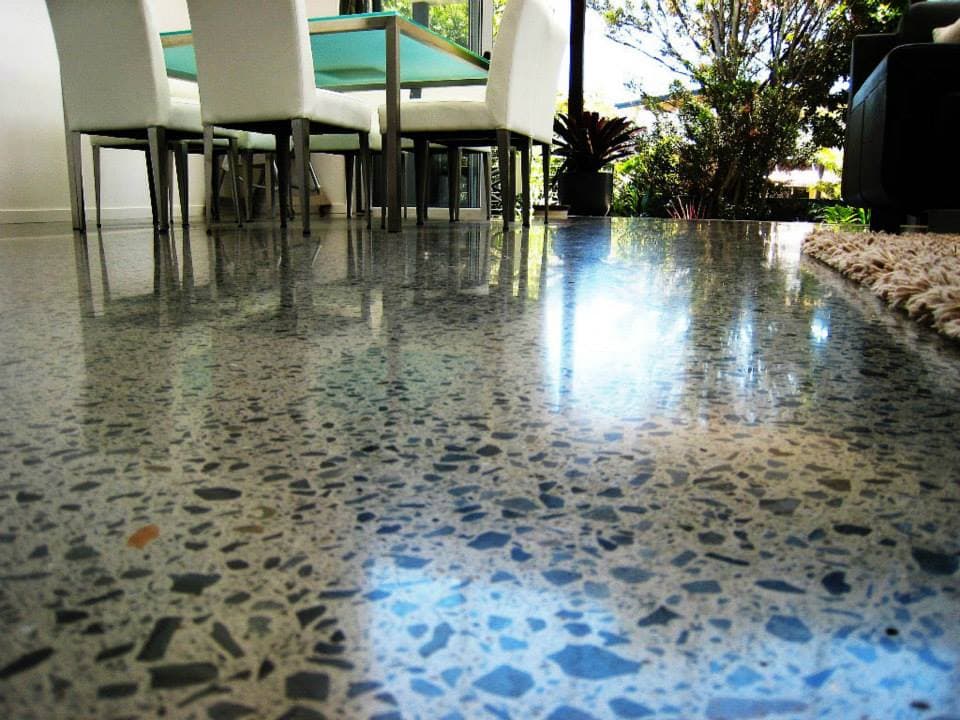
Photograph: Honed and polished concrete floor surface. by Multiblast122. Source on Wikimedia Commons, licensed CC BY-SA 4.0. See all image credits.

Underfloor heating in Australia is no longer only a ski-house story. Hydronic slabs in the south, electric mats in bathrooms, and the odd retrofit under a new kitchen have become ordinary enough that flooring has to answer. Heat is a moisture and movement event. It is also a warranty event.
This sits in the design hub because it is chosen with the room, but it is really a technical overlay on timber, tiles and resilient floors.
Two systems, two personalities
Hydronic in a slab is a building system. The slab is the radiator. Tiles, stone, and some toppings love it. Timber and resilient floors may sit on top if the surface temperature is controlled and the product is approved. Response is slow; it is a climate, not a switch.
Electric mats are faster, often used in bathrooms and kitchens as a luxury rather than a whole-house heat. They still have maximum temperatures. They still need a compatible wearing surface and adhesive. They are not a reason to skip wet-area membranes.
Tiles and stone: the easy friendship
Ceramic assemblies over heated slabs are a known trade if the adhesive is flexible and rated. Large formats still need flatness and joints; heat adds movement. Stone needs the same sealing honesty as ever.
Honed or polished concrete can be the heated floor — our cover — if the slab was designed for it. Retrofitting a grind onto a slab that was not poured for appearance is a different budget.
Timber: engineered first, limits always
Approved engineered products, often with plywood cores, can live over heat if you:
- keep surface temperatures in the manufacturer’s band (often around 27 °C, but the sheet wins)
- use the specified glue or floating system
- control humidity so the boards do not dry into canyons
- do not throw rugs the size of Tasmania on day one (hot spots)
Solid hardwood is the fussy guest. Some overlay solids are allowed; many are not. Wide solids over heat is how cupping case studies get new chapters — repairs.
Hybrid and vinyl: read the PDF
SPC can be a good conductor relative to a thick pad. The attached pad that makes it quiet can also make it a jumper. Some ranges allow heat, some cap it, some void the warranty if you try. Glue-down LVT is often the more predictable resilient over electric mats.
Laminate’s HDF does not enjoy being a radiator. Be sceptical.
Rugs, furniture and the empty-room problem
Heat wants to leave the floor. A leather sofa with a solid plinth, a sheepskin the size of the room, a display kitchen with no air — all of them change the system. Follow the heating engineer, not only the floor brand.
Commissioning
Turn systems up slowly. Timber especially wants a boring ramp, not a blast to impress the client on handover Friday. Moisture readings before, during, after.
A pairing cheat-sheet
- Bathroom luxury: electric mat + structured tile.
- Southern living: hydronic slab + tile, stone, or approved engineered.
- Family open plan: hydronic + hybrid only if approved, else tile in the wet and engineered in the sit.
- Heritage boards you love: maybe do not heat them; heat the room another way.
Warm feet are wonderful. Cooked timber is not. Floorscapes is in favour of the engineer’s number over the lifestyle still.
Running costs, rugs and the rest of the heating plan
Underfloor is slow comfort. It is a poor partner if you only heat the house from 6 to 7 pm. Hydronic slabs want to be at a boring temperature most of the afternoon. If your household is in and out, a faster system at the edge of the room may still be needed. The floor covering’s R-value changes how much heat arrives at your socks. Thick pads, thick carpets, and huge rugs are insulators. Design them with the engineer.
Bathrooms with electric mats should still be zoned so you are not heating a shower you forgot to turn off for twelve hours. Timers are part of the floor.
If you are on a slab in the north that never wants heat, skip this product and spend on shading and ventilation. Underfloor heating is a southern and alpine conversation more than a Darwin one. Specify for the climate you have, not the climate in the European brochure.
Commission slowly, document surface temperatures, and keep the floor manufacturer’s heated-subfloor PDF with the warranty. The pairing cheat-sheet in the main essay still holds. Warm feet are the brief. Cooked veneer is the failure mode.
Retrofits, ceiling heights and the myth of the thin mat
Retrofitting electric mats eats height. Doors, dishwashers and transitions to old timber all shift. A “thin” mat plus tile adhesive plus tile is not thin. Draw the section. Hydronic retrofits are rarer and more invasive. Sometimes a good heat pump and a rug are the better Australian retrofit. Underfloor is wonderful when the building was designed for it, and expensive theatre when it was not.
Kids on tiles and the morning you forgot the timer
A heated bathroom tile is lovely until a toddler meets a surface you accidentally left on high. Limit temperatures, use timers, and still choose a slip rating for wet feet. Heat does not cancel AS 4586. If the system is a luxury, treat it as a luxury with a switch you can understand at 6 am. The floor covering still has to be the right floor covering when the heat is off in December.
Insulation below, not only coverings above
Heat that goes into an uninsulated slab edge is heat you paid for and the garden received. Floor coverings cannot fix a slab that was not insulated. If you are pouring new, talk to the designer about edges and insulation before you talk about oak. If you are retrofitting a mat, accept that some heat is going the wrong way. Underfloor heating is a building conversation with a floor on top. Keep the order.
People also ask
- Can you put timber floors over underfloor heating?
- Many engineered timbers are approved if you follow the temperature limits and installation method. Solid hardwood is more restricted. Always use the floor manufacturer’s heated-subfloor guide, not a general feeling that wood is warm.
- Are tiles good with underfloor heating?
- Yes. Tiles and stone are efficient wearing surfaces over hydronic slabs or electric mats, with the right adhesive. They also stay cool when the system is off, which is the deal.
- Can hybrid flooring go over underfloor heating?
- Some SPC ranges allow it below a maximum surface temperature. Pads and underlays can be insulators you do not want. Check the range; do not assume.
Continue in the Rooms and Australian houses hub or read the Floorscapes editorial standards. Pitch a related essay on the write for us page.